Aussie Beef & Lamb Take Centre Stage at Exclusive London Masterclass

On Tuesday, 3rd February, we had the pleasure of hosting an exceptional Taste of Australia: Beef & Lamb Masterclass & Lunch at Sexy Fish in London’s Mayfair. Held in the iconic Coral Room, the event brought together 50 meat-loving chefs for an immersive exploration of the true taste and farm-to-fork story of Aussie Beef & Lamb.
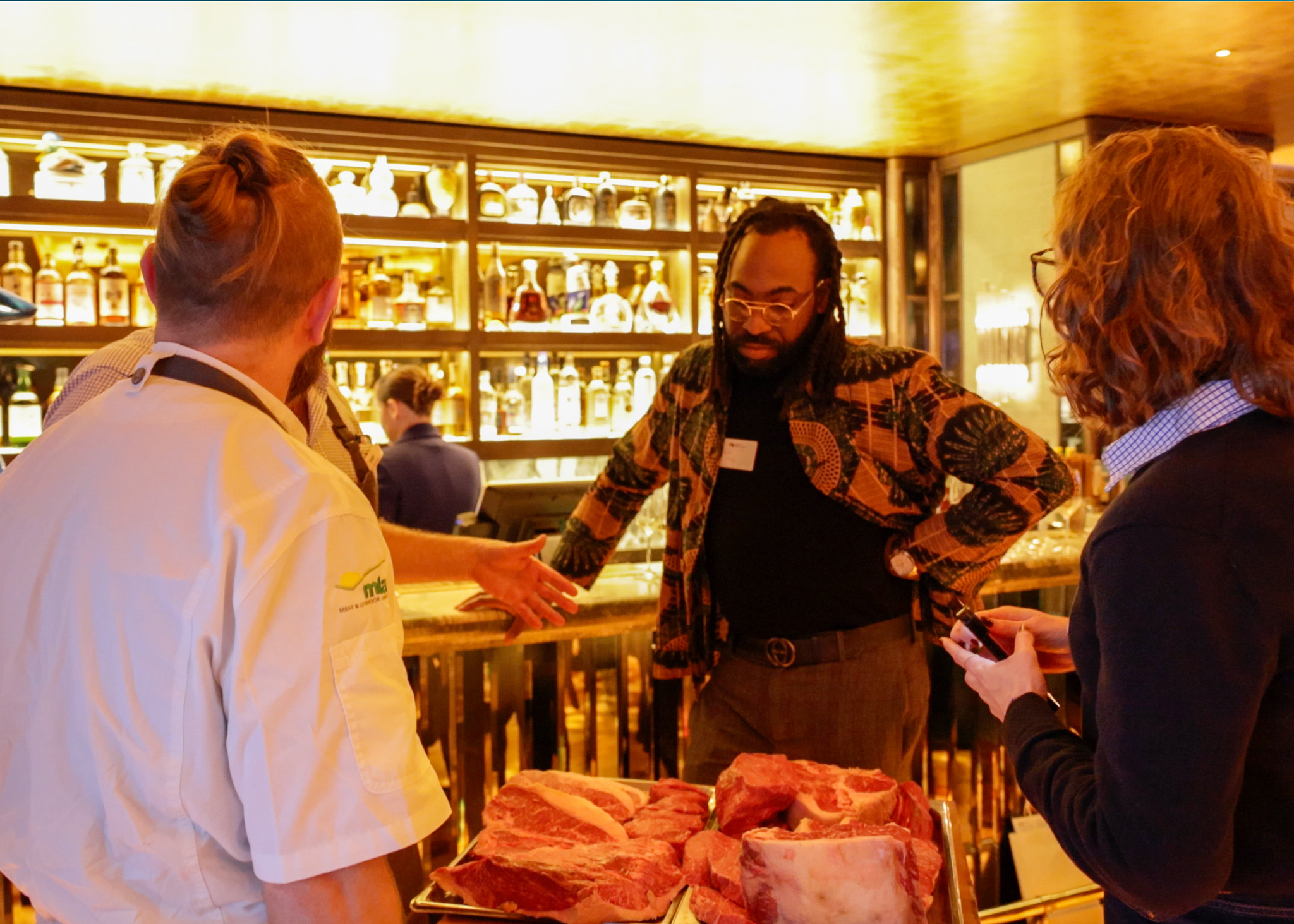
It was a fantastic opportunity to open the sliding doors of the Private Dining Room ‘The Coral Room’ to a space filled with culinary talent, curiosity, and genuine appreciation for world-class Australian beef and lamb.
The Coral Room boasts two of the largest indoor coral reef tanks globally and was filled with an engaged mix of chefs, wholesalers, ‘Aussie Beef Mates’, and ‘Lambassadors’, creating a lively environment for learning, discussion, and networking. Conversations flowed as freely as the inspiration, from sustainability and provenance to cut optimisation and menu value.
Guests were given an insight into Australia’s internationally renowned beef and lamb production, with practical details about grass-fed and grain-fed cuts, flavour development, and consistency. The masterclass was perfectly complemented by a beautifully curated lunch that showcased premium Aussie cuts through the distinctive Sexy Fish style: Japanese-inspired cuisine, refined and flavour-focused.

Richard Sanders, UK Country Manager, Meat & Livestock Australia, said
“This event allowed us to share the story behind Australian beef and lamb, from its origins and sustainable and high-welfare farming methods to the outstanding quality Aussie cuts that chefs enjoy on the plate. Seeing our premium, globally Halal-certified cuts come to life through the menu yesterday truly reinforced why Aussie beef and lamb remain a popular choice for today’s menus.”
From expertly cooked lamb and beef dishes to lively table debates about sourcing and application, the afternoon achieved the perfect balance between education and indulgence.

The energy in the room clearly showed this wasn’t just a Chef’s Lunch and Aussie Butchery Masterclass; it was a shared celebration of high-quality meat, genuine Aussie butchery expertise by Dan Epsley, and culinary excellence and collaboration across the food industry.
Guests enjoyed an outstanding tasting menu curated by Mattia Ricci, Executive Chef at Sexy Fish, ably assisted by Professional Cookery students from West London College, highlighting the exceptional versatility and global appeal of Australian beef and lamb. The menu featured impressive canapés, including beef skewers with ancho chilli glaze and lamb tacos with an oriental dressing, progressing to beautifully presented dishes such as lamb rump with red kosho and herbs as a starter.
 The show-stopping main courses celebrated Australian produce with contemporary and innovative flavour combinations, including lamb rack with gochujang, goma and cucumber, wagyu short ribs with ras el hanout and pickled apple salad, and Black Angus striploin with steak miso sauce and purple potato crisps.
Chef Mattia said:
“I really enjoyed today; the Aussie short ribs were a real hit, and I’m going to add them to the menu. I’m also very proud of the West London College students who helped out today and have truly enjoyed having them here at Sexy Fish for work experience this month. It was great to work with such a top-quality product – thank you, Meat and Livestock Australia.”
No Aussie beef or lamb in these little sweet treats, but the famous Sexy Fish doughnuts and Sexy Fish Treats in the form of a delicious Nut Chocolate Bar and Pate de Fruit, which were the perfect end to the perfect luncheon.
The menu skilfully blended technical expertise with playful creativity, highlighting Sexy Fish’s signature cuisine while placing Australian beef and lamb centre stage. It was a lovely afternoon with great company and a reminder of why Aussie beef and lamb continue to dominate the top tables of the UK’s finest restaurants.
 Emma Boughen, Business Development Manager, UK concluded,
“Our ‘Taste of Australia’ Beef & Lamb Masterclass and Lunch, in collaboration with The Chefs’ Forum, showcased what makes Australian beef and lamb so special. Bringing together chefs, wholesalers, ‘Beef Mates’, and ‘Lambassadors’ in one inspiring space generated authentic energy and engagement, and the feedback on the provenance, quality, and versatility of the beef and lamb was outstanding. It was a fantastic opportunity to demonstrate how Australian red meat consistently offers flavour, trust, and performance for chefs.”
For more information to get Aussie Beef and Lamb on your menu, email: eboughen@mla.com.au
Visit: www.aussiebeefandlamb.co.uk
Photography & film by Carlos Farinha @carlosclickuk
Inside the Schloss: The Chefs’ Forum Academy Students Go Behind the Scenes at Albert’s Schloss Birmingham
 This week, a group of our Chefs’ Forum Academy students from South & City College Birmingham stepped away from the classroom and into the heart of Birmingham’s vibrant hospitality scene for an immersive industry day at Albert’s Schloss.
The day gave the students a glimpse of what their careers could look like after finishing their course, offering a 360 degree look at how one of the city’s most successful venues operates.
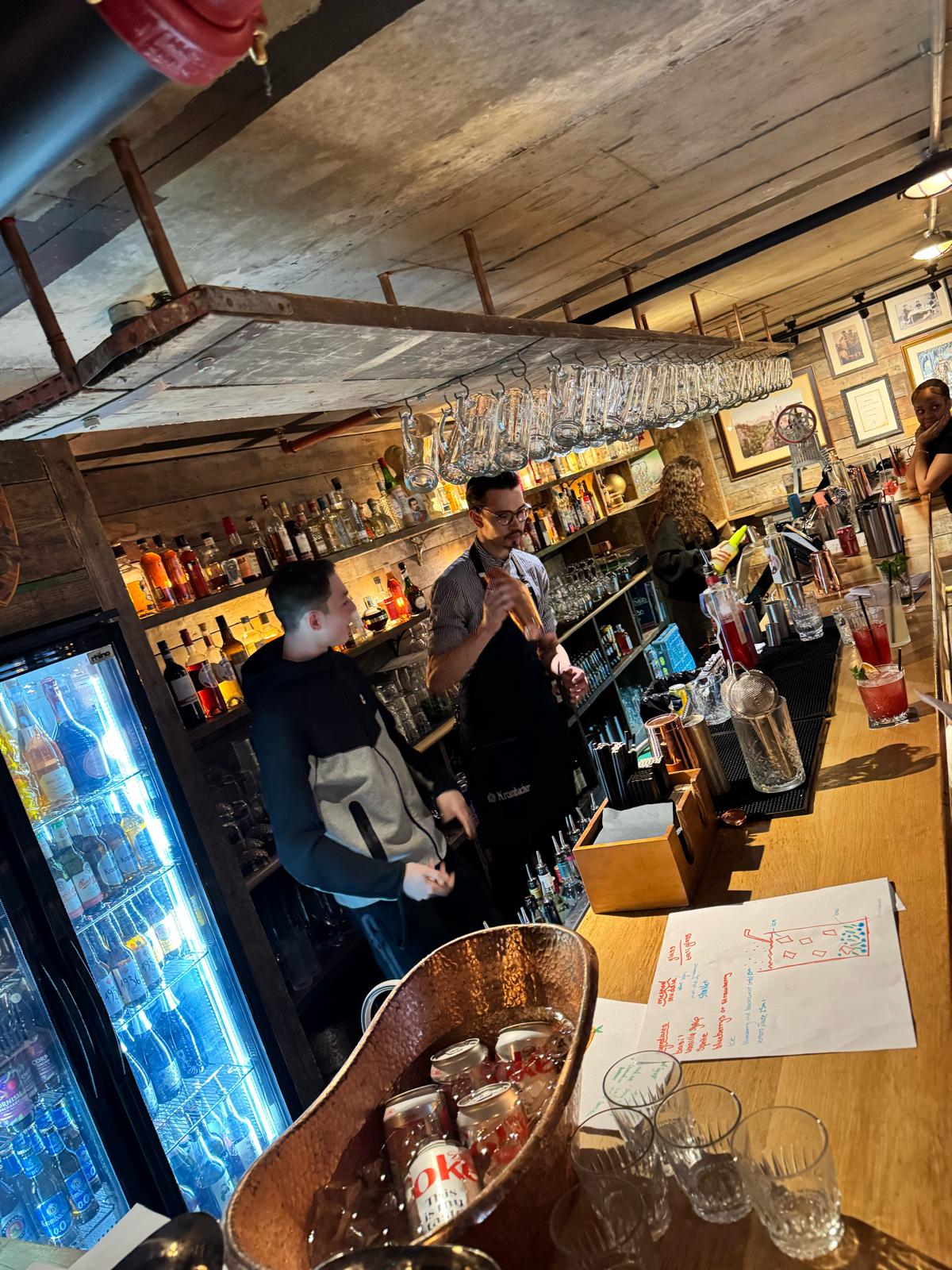 The morning kicked off with a burst of creativity. After an introduction to the Schloss brand, students were challenged to get behind the bar for a mocktail masterclass. Not only did they learn the recipes, but they were also tasked with creating their own signature alcohol-free mocktails, testing their understanding of flavour profiles and presentation.
The deep dive continued with an exclusive tour of the storerooms led by James Plant, Head of Openings & Innovation. James gave the group a fascinating look at how they make schnapps, explaining the intricate process of how the venue develops and produces its signature flavours.
A hospitality experience wouldn’t be complete without the food. After a communal lunch, the session transitioned into an informal industry careers chat. This was a rare opportunity for students to sit down with the people who keep the engine running, including:
- Jacqui Roylance, Head of Talent
- Adin Memetovic, Operations Manager
- James Plant, Head of Openings and Innovation
- Ben Warnock, Deputy General Manager
- Viktoria Stanislavova, Trainee Assistant Manager
- Richard Goldingay, Bar Trainer
- Anna Kobylnik and Anna Dlugolecka, People Team
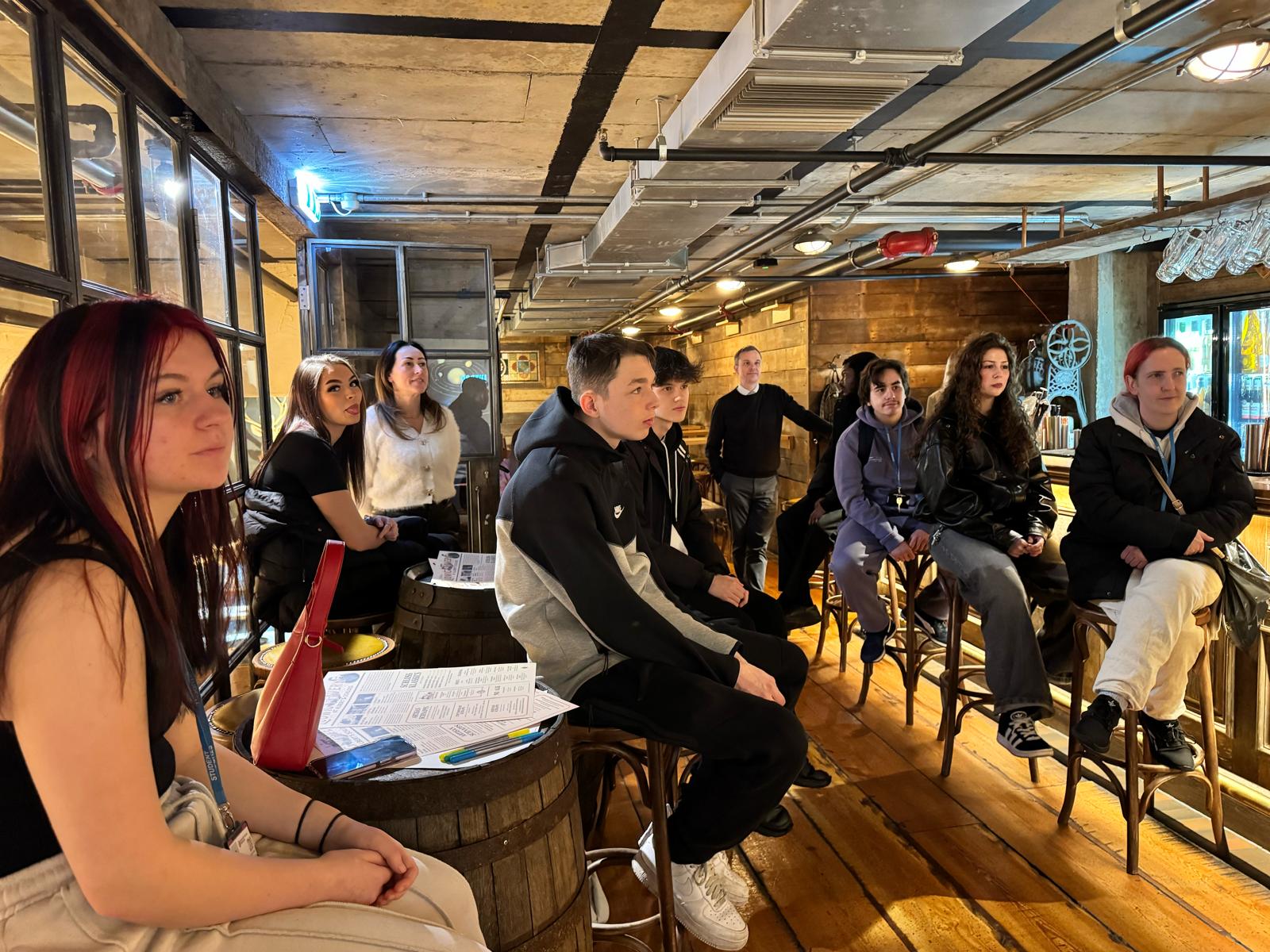 The Q&A session allowed students to ask candid questions about career progression, the daily challenges of management, and the skills needed to succeed in a high-volume venue. By hearing from both senior leadership and those just starting their management journeys, students left with a clear roadmap of the diverse career paths available within the industry.
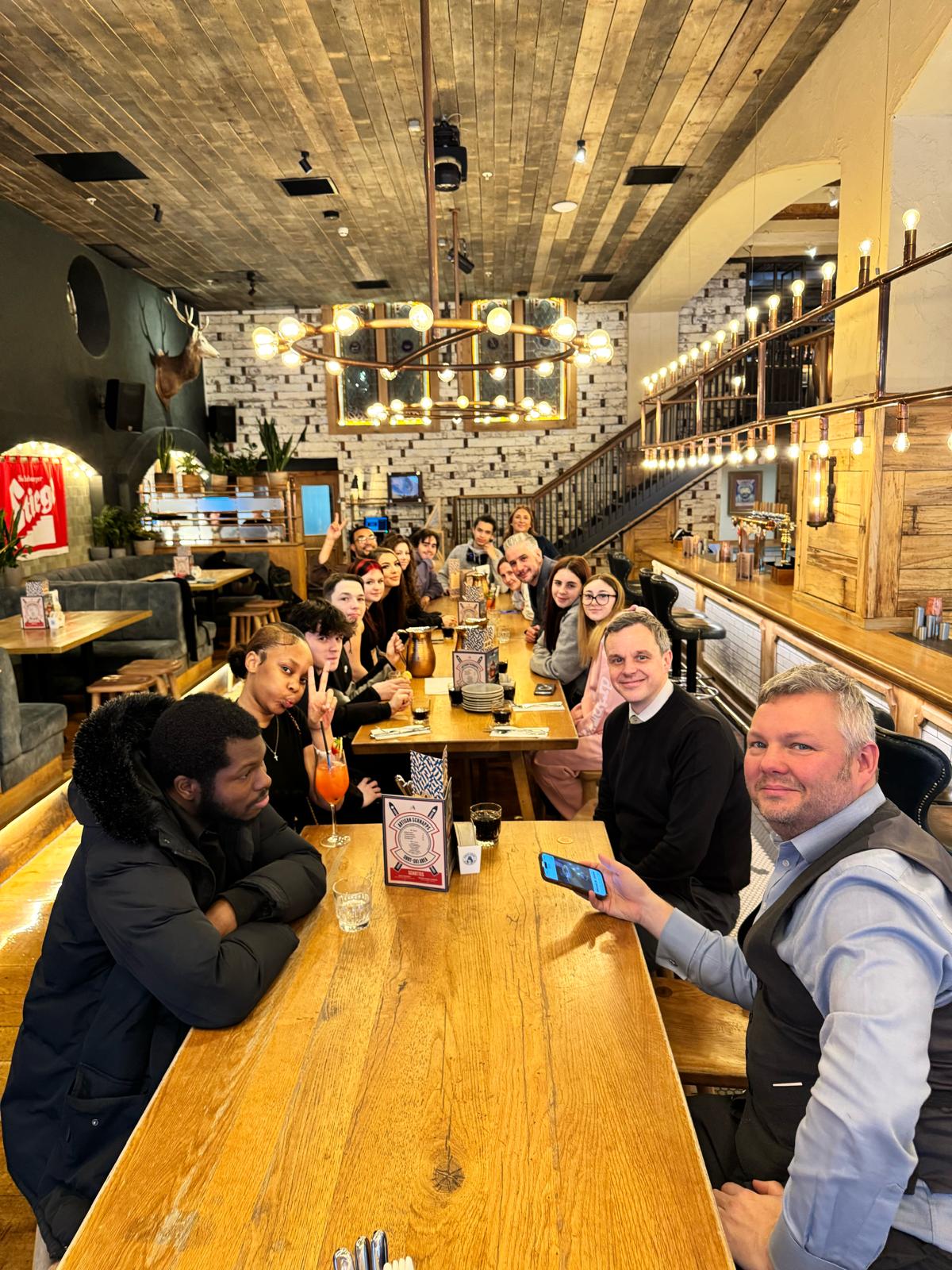 “Our visit to Albert’s Schloss was an incredible success. The day provided our students with high-energy, real-world experience that you simply can’t replicate in a classroom. It was wonderful to see them so engaged with the team. The session didn’t just teach them new skills; it truly reinforced and reinstated their prior learning by putting theory into practice.” Sheri Cadwallader, Senior Technician at South & City College Birmingham.
“Days like this are so important for us as a business. Giving students hands-on exposure to real hospitality environments helps bridge the gap between learning and industry, and the students were fantastic – curious, engaged and full of ideas. Watching them design and build their own mocktails with our team was a real highlight, and it’s exciting to see such strong future talent coming through hospitality.” Jacqui Roylance, Head of Talent at Albert’s Schloss.
A huge thank you to the entire team at Albert’s Schloss Birmingham for hosting such an inspiring and educational day!
Chef of the Week Sponsored by Pure Ionic Water: Daniel Rouncefield, Head Chef at The Watch House in Cornwall
 Chef of the Week sponsored by Pure Ionic Water celebrates the chefs that embody Pure Ionic Water’s core philosophy of ‘enhancing the culinary experience‘.
Pure Ionic Water works in many kitchens up and down the country from the pinnacle of Michelin stars to 5-star hotels, uniting them all, the desire to serve the very best. Understanding the difference premium hydrogen enhanced alkaline water makes to food, to the kitchen team’s performance and ultimately to the business’s profits is easy, just ask around.
“I only trust Pure Ionic Water at home and in my restaurant.”
Sat Bains, Chef Parton, Restaurant Sat Bains, 2 Michelin stars
For more information about Pure Ionic Water CLICK HERE
How long have you worked at your current restaurant?
I have been at The Watch House for the last 7 months, taking on the head chef role 5 months ago, leaving my private catering business to come and get hands on back in the kitchen.
Where did your passion for cooking come from and where did you learn your skills?
It has always been something I have done. From a young age, I was baking with my mother and prepping fresh fish that my father had caught as a fisherman in St. Ives. I learnt how to pick crab at the age of five, so fresh local ingredients have always been something that has been available to me. I then spent 5 years in Cornwall College completing my NVQ 1,2 and 3 in cookery and a second level 3 in patisserie, winning student of the year 3 years running, I knew it was something I would do forever.
What do you enjoy most about being a chef?
The feeling you get at the end of a busy shift, where you can’t quite believe what you have just managed to do. You get a buzz like no other, it’s such a rush of adrenaline it becomes an addiction.
Name three ingredients you couldn’t cook without.
This is a tough one, I think every chef has to say salt, but I would go one further and say Maldon Sea Salt. I think it is the best. Then, of course, fresh local fish, and lemon!
Which piece of kitchen equipment couldn’t you live without?
My cookery style is pan work without any fancy equipment or tools. I do like my Hexclad pan.
What food trends are you spotting at the moment?
I think more people are accepting only using seasonal fish and trying new things at certain times of the year rather than stick to what they know. When they do accept, it’s much better as it’s not been frozen or farmed, and you can call the difference.
What do you think is a common mistake that lets chefs down?
Over complicating dishes, not trusting the ingredients they have, less is more.
What is your favourite time of year for food, and why?
It has to be winter, putting a twist on heart warming classic dishes, such as my hake bourguignon. It’s a real hearty dish with a depth of flavour and the twist of a beautifully cooked hake fillet on top.
Which of your dishes are you most proud of?
Other than the hake bourguignon, I do brag about my sticky toffee pudding. It’s light but sticky, I learnt it when I was 16 and it’s the one recipe that has stuck in my head for 20 years, finished with a sea salt caramel – there is nothing better.
How do you come up with new dishes?Working with other chefs, eating in other restaurants, and playing in my kitchen on time off. Ideas are everywhere, you have to look on social media or in magazines, then change it to fit your style and make the dish your own.
Who was your greatest influence?
The chefs I got to work with growing up. I started at 14 in the kitchen of The Seafood Cafe in St. Ives. I worked there for 8 years under 2 chefs, Richard Asquith & Stephen Smith. Not only did these chefs take the time to teach me everything they knew from prep, cooking and running a kitchen, they helped me grow up from a teenager to a man. We spent 70+ hours a week together for 8 years, I wouldn’t be who I am today without them.
Tell us three chefs you admire.
Tom Brown, I went to college with him and love what he has managed to achieve. Tom Kerridge, the style I also seem to have fallen in love with, and Yotam Ottolenghi – his book simple, brilliant.
What is your favourite cookbook?
Tough one, the one I use the most is ‘The Flavour Thesaurus’ – more so to teach me some pairings I may not have thought of, then turn them into a dish myself.
Who do you think are the chefs to watch over the next few months?
The Aussie Smoker, Adam Kesacoff – He is going from strength to strength and growing his incredible food. Definitely one to watch.
What’s been your favourite new restaurant opening of the last year?
I’m looking forward to Robo Asian bar and canteen opening in Newquay very soon, as their first one in Falmouth is great, but this one is even bigger.
Bringing Lentils to Life: Culinary Inspiration at the University of Strathclyde
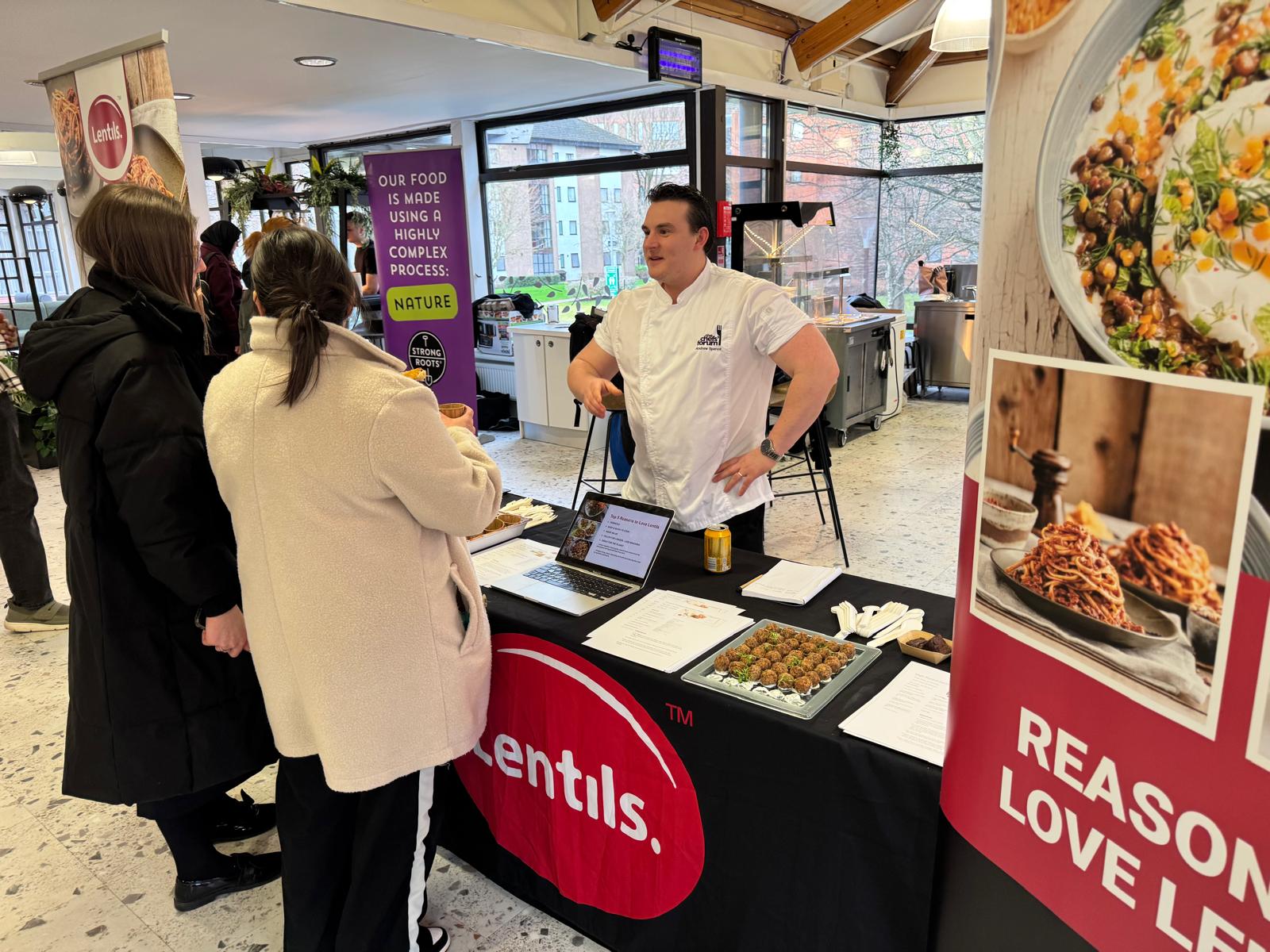 On 29th January, the University of Strathclyde hosted their ‘Menu for Change’ event. This drop-in session was designed as a trade-show style event, bringing together various suppliers to showcase sustainable food products to approximately 100 staff and students. In partnership with Lentils.org, The Chefs’ Forum facilitated the involvement of Chef Andy Spence, who was tasked with bringing the versatility of pulses to life through interactive sampling.
 Operating from the Lentils.org stand, Andy utilized the on-site kitchen facilities to prepare a diverse range of dishes that challenged traditional perceptions of lentils. The menu spanned from breakfast to dessert, featuring soft and chewy lentil granola bars, mini curried lentil cakes with herbed yoghurt, and lentil keftedes. He also demonstrated how lentil hummus could serve as a cost-effective, nutritious alternative to mayonnaise in wraps, and even showcased a ‘sweet’ application with rich lentil brownies.
Reflecting on the event, Andy said, “What a fantastic turn out in Glasgow. The students loved the hummus the most, and I must admit having lentils instead of chickpeas – it’s better! Lentils are one of the most versatile ingredients, yet no one knows it!”
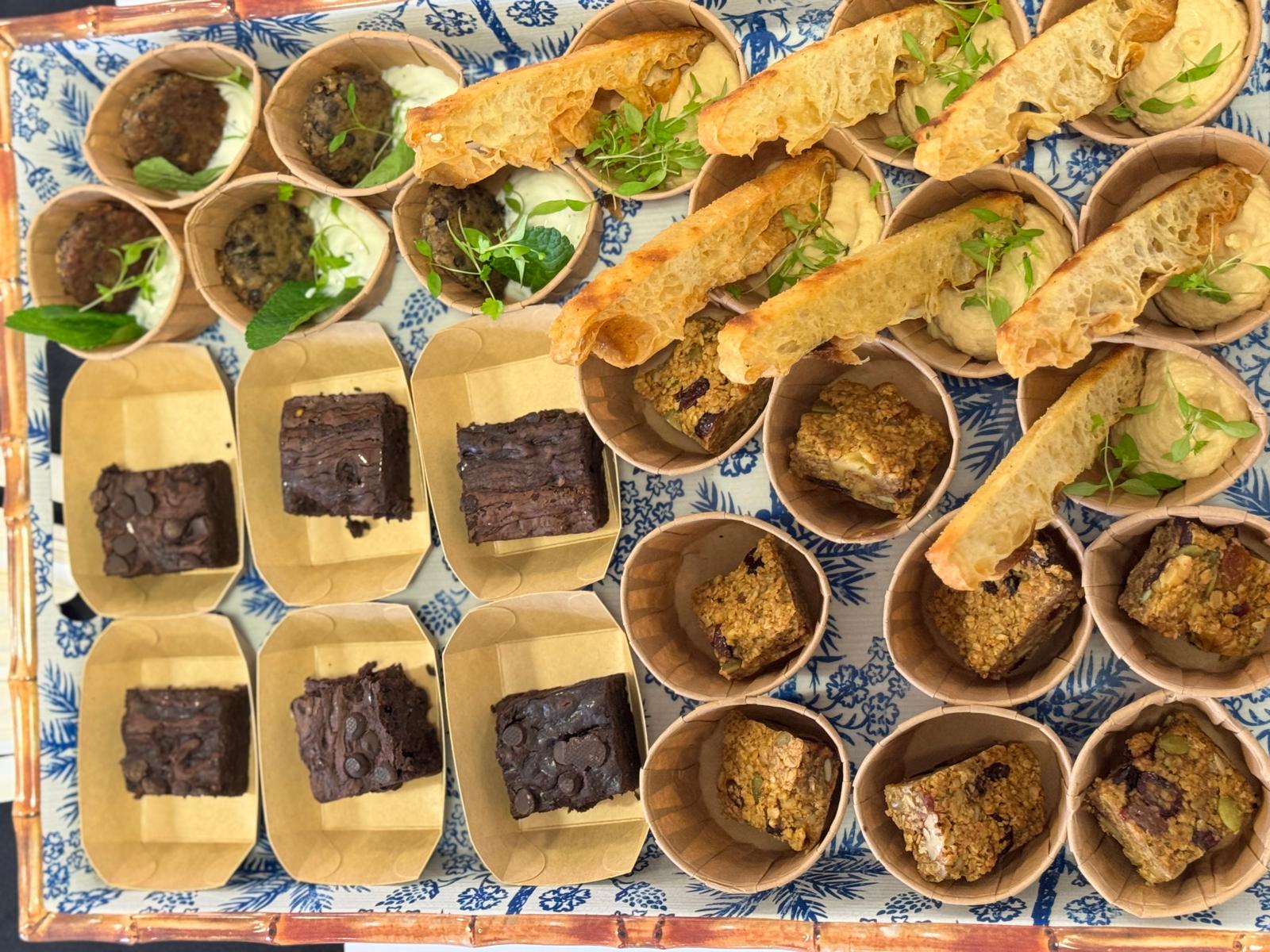 The presence of a professional chef proved invaluable for attendee engagement. Speaking on behalf of Lentils.org, Ellie Taylor noted, “Thanks to the Chefs’ Forum, we were introduced to Andy, who helped us bring lentils to life… He prepared an inspiring selection of dishes demonstrating their versatility and appeal. Andy enthusiastically encouraged students and staff to try the samples and offered helpful advice on adapting recipes to meet a variety of dietary requirements.”
By combining sustainable sourcing and culinary excellence, this partnership demonstrated how expert coordination can turn a simple ingredient into a powerful solution for modern, inclusive menus.
National NHS Chef of the Year Nedko Rusev Launches Low-Carbon Menu at St Thomas’ Hospital
 If we all make small adjustments in our own environments, we can bring about meaningful change. This idea was introduced during our recent series of Carbon and Sustainability Workshops in collaboration with NHS England and Dr Andrea Zick from Brunel University. This principle also underpins a pioneering new low-carbon menu launched at St Thomas’ Hospital by Nedko Rusev, NHS National Chef of the Year, alongside Catering Manager Annette White.
The menu marks a major advancement in sustainable healthcare catering, combining culinary excellence with environmental responsibility on a large scale. Serving thousands of patients, staff, and visitors daily, St Thomas’ demonstrates how climate-conscious food can be both appealing and practically implemented within the public sector.
 At the centre of the launch is a standout dish: venison and lentil moussaka. This hybrid recipe intentionally reduces the amount of red meat while preserving flavour, nutrition, and familiarity. By combining roughly 50% venison with 50% lentils, the dish achieves a significantly lower carbon footprint while maintaining high protein content and customer appeal.
Tim Radcliffe, Net Zero Food Programme Manager at NHS England, advocates for including both low-carbon wild venison and lentils in hospital menus. He has also been collaborating with Ned and the team to develop a ‘Meat Me Half Way’ menu, reformulating recipes to contain less red meat and enhancing nutritional value with lentils or pea protein, while also reducing carbon footprint. Check out Tim’s message in this film from the menu development day at West London College.
Go and Eat Lentils!
The inspiration behind the moussaka can be traced back to the public sector lentil menu development day at West London College, followed by further refinement during lentil cookery masterclasses delivered for Lentils.org with Nedko and his brigade at the hospital. What began as collaborative development work has now translated into real-world application on a major NHS menu – a powerful example of knowledge transfer in action.
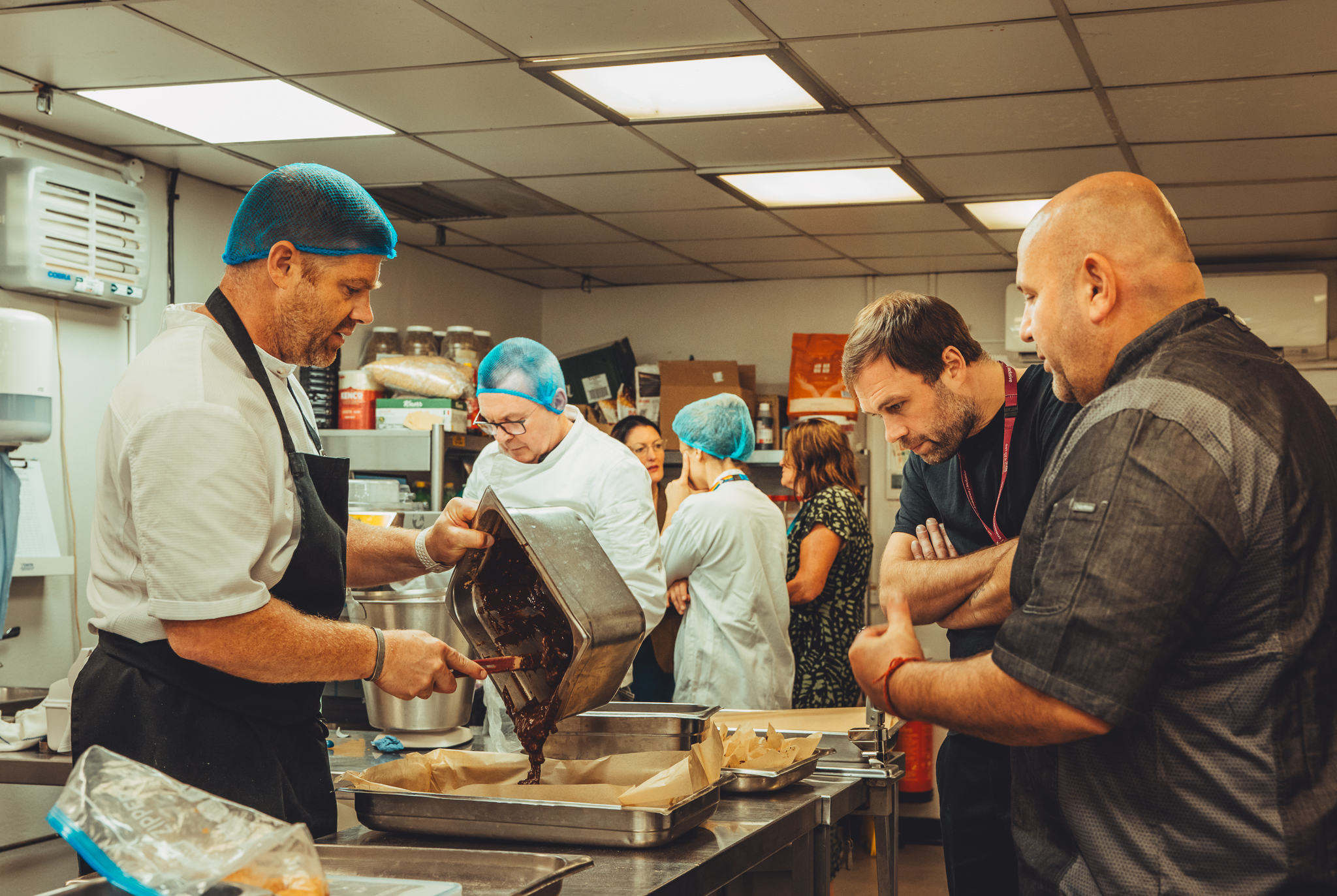 The wider menu showcases a strong emphasis on plant-forward and low-impact dishes. From the menus in circulation, diners can choose options such as venison and lentil chilli, shepherd’s pie made with venison and lentils, plant-based cottage pie, sweet potato, chickpea and spinach curry, vegetable frittata, lentil and vegetable soups, and coconut bean stew. These sit alongside responsibly sourced fish, reduced-meat classics and clearly labelled vegan and vegetarian dishes.
A traffic-light style carbon labelling system is used across the menus, supported by QR codes that enable customers in the retail restaurant to scan for allergens, nutrition, and sustainability data. Behind the scenes, everything from procurement and recipe formulation to carbon calculation, menu costing, and waste monitoring is integrated into a single system, making sustainability measurable rather than abstract.
Food waste reduction remains a key part of the programme, with plate waste, production waste, and counter waste carefully monitored. Used cooking oil is collected and converted into biofuel for the iconic London buses, while surplus food redistribution is integrated into the broader environmental strategy. Collectively, these steps demonstrate how operational details support the overall ambitions.
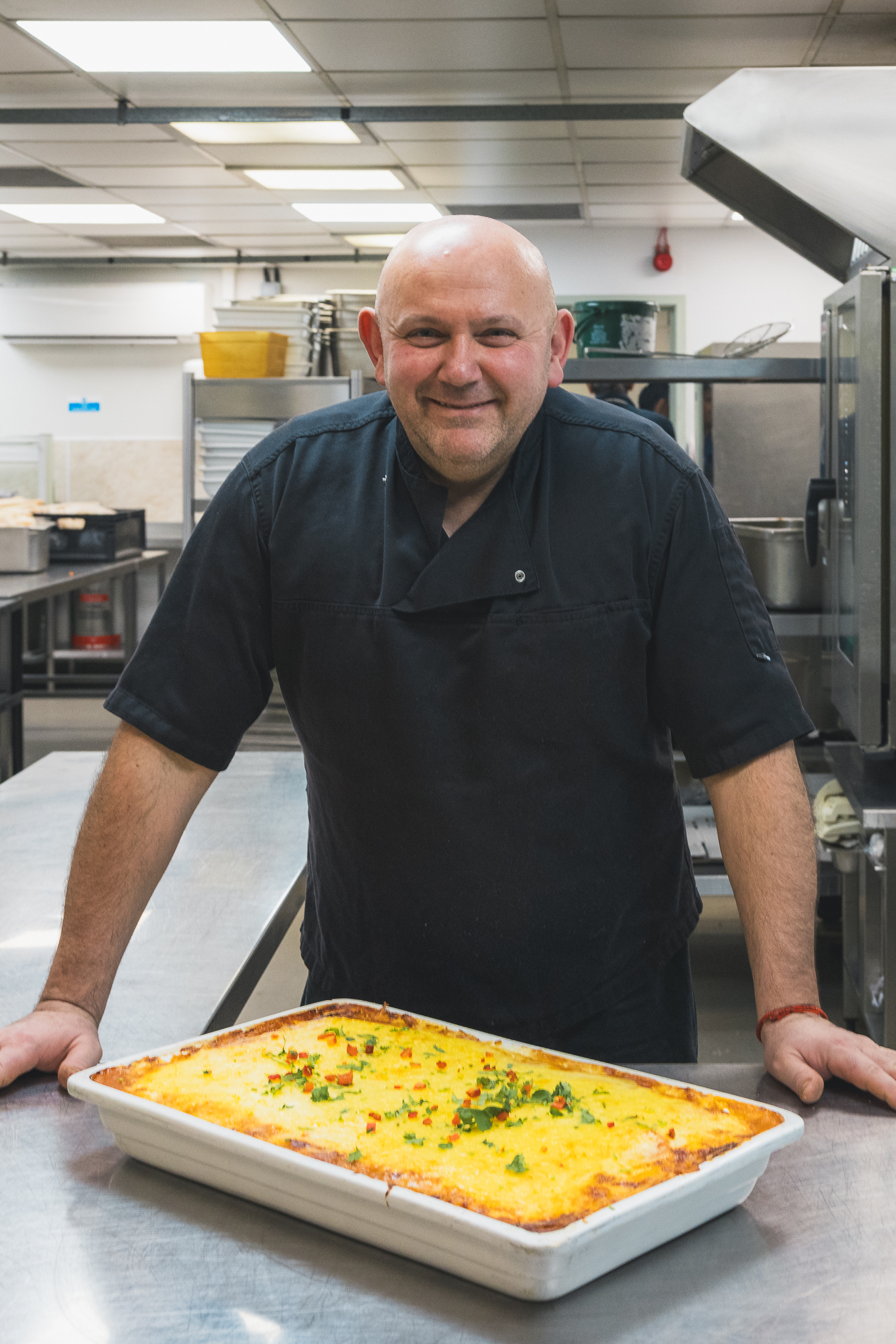
 Nedko’s approach is based on pragmatism rather than perfection. “We’re not asking everyone to change everything overnight,” he has said previously. “But if each of us makes small, thoughtful changes where we can, the cumulative impact is enormous.” That message resonates strongly in a healthcare setting, where scale amplifies both problems and solutions.
Looking ahead, this work remains far from finished. Nedko and Annette will contribute seasonal, carbon-friendly farm-to-fork recipes to our third book centred on sustainable healthcare catering:
The Healthcare Chefs’ Knowledge 3: Provenance & Seasonality – From Research to Practice.
This is our third publishing collaboration with NHS England that aims to share insights well beyond St Thomas’ from our workshops and research conducted with healthcare chefs and foodservice stakeholders throughout 2025.
Nedko and Annette will also collaborate closely with Denise Charles and the teaching team at West London College to establish a work experience programme, allowing students to gain firsthand exposure to public sector and healthcare catering at its best. Students will have the opportunity to see how food, sustainability, systems, and leadership come together within an exemplary NHS Trust.
 In a time when climate targets can seem daunting, St Thomas’ Hospital offers a powerful reminder: meaningful change isn’t always about big gestures. Sometimes, it begins with a lentil.
Photography by Carlos Farinha @carlosclickuk
A Landmark Opening for Culinary Education at the University of West London
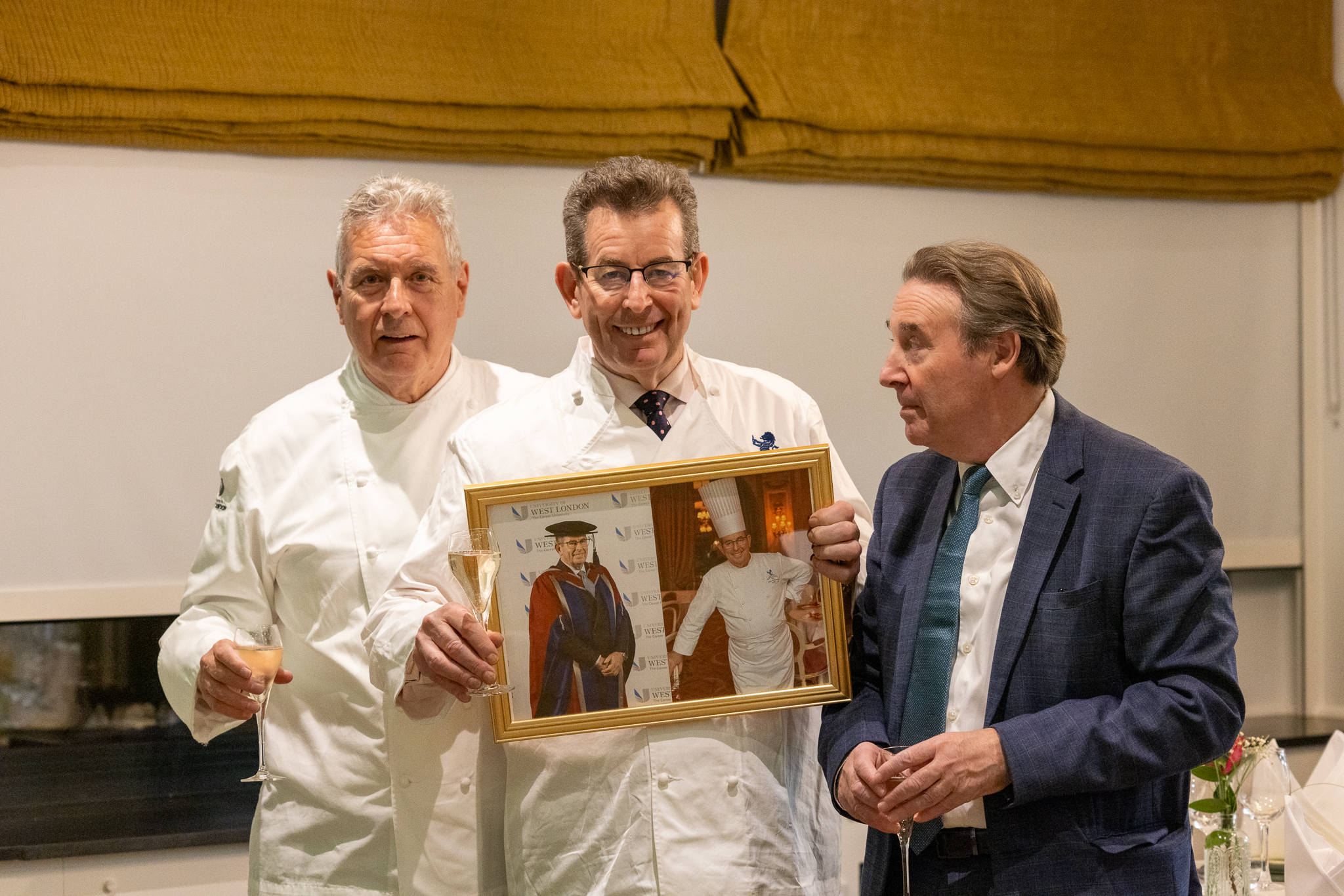
L-R – Michael Coaker, John Williams MBE, Peter John CBE
It was a genuine privilege for The Chefs’ Forum to be invited to attend and capture the official opening of The Chef’s Table at Pillars Restaurant, University of West London, an event that marked a significant moment for culinary education, hospitality leadership, and the future of food in the UK.
The room was filled with an exceptional gathering of talent, bringing together some of the country’s most respected culinary figures alongside influential food business leaders, educators, and industry partners. The atmosphere was both celebratory and purposeful, reflecting a shared commitment to excellence, mentorship, and the development of the next generation of chefs.
 Designed as an immersive dining and learning space, The Chefs’ Table represents far more than a new restaurant environment. It is a statement of intent, a bridge between professional kitchens and education, where students will learn directly from industry leaders in a real-world setting. The initiative places University of West London firmly at the forefront of progressive hospitality training, combining technical skill, creativity, sustainability, and commercial awareness.
Professor Peter John CBE, Vice-Chancellor and President of the University, welcomed the guests to the event and thanked them for their much-valued support of the University.
The highlight of the event was the official ribbon-cutting ceremony led by John Williams MBE, Executive Chef of The Ritz London, whose presence underscored the occasion’s significance. A long-standing advocate for education and talent development within the hospitality sector, Williams brought both gravitas and warmth to the opening.
 Speaking at the event, he said:
“The Chefs’ Table space, here in Pillars is vital for the future of our industry. It gives young chefs and front-of-house professionals the chance to learn in an environment that reflects the standards, discipline, and pride of professional kitchens and luxury hospitality. Investing in education like this is how we safeguard culinary and service excellence for generations to come.”
The moment was made even more meaningful given Williams’ recent recognition by the University of West London, where he was awarded an honorary doctorate in acknowledgement of his outstanding contribution to the culinary profession and hospitality education. His involvement symbolised the powerful connection between industry excellence and academic advancement, a theme that resonated strongly throughout the evening. Williams was presented with a framed photo of his graduation, with a photo of him in his whites next to it to celebrate this connection.
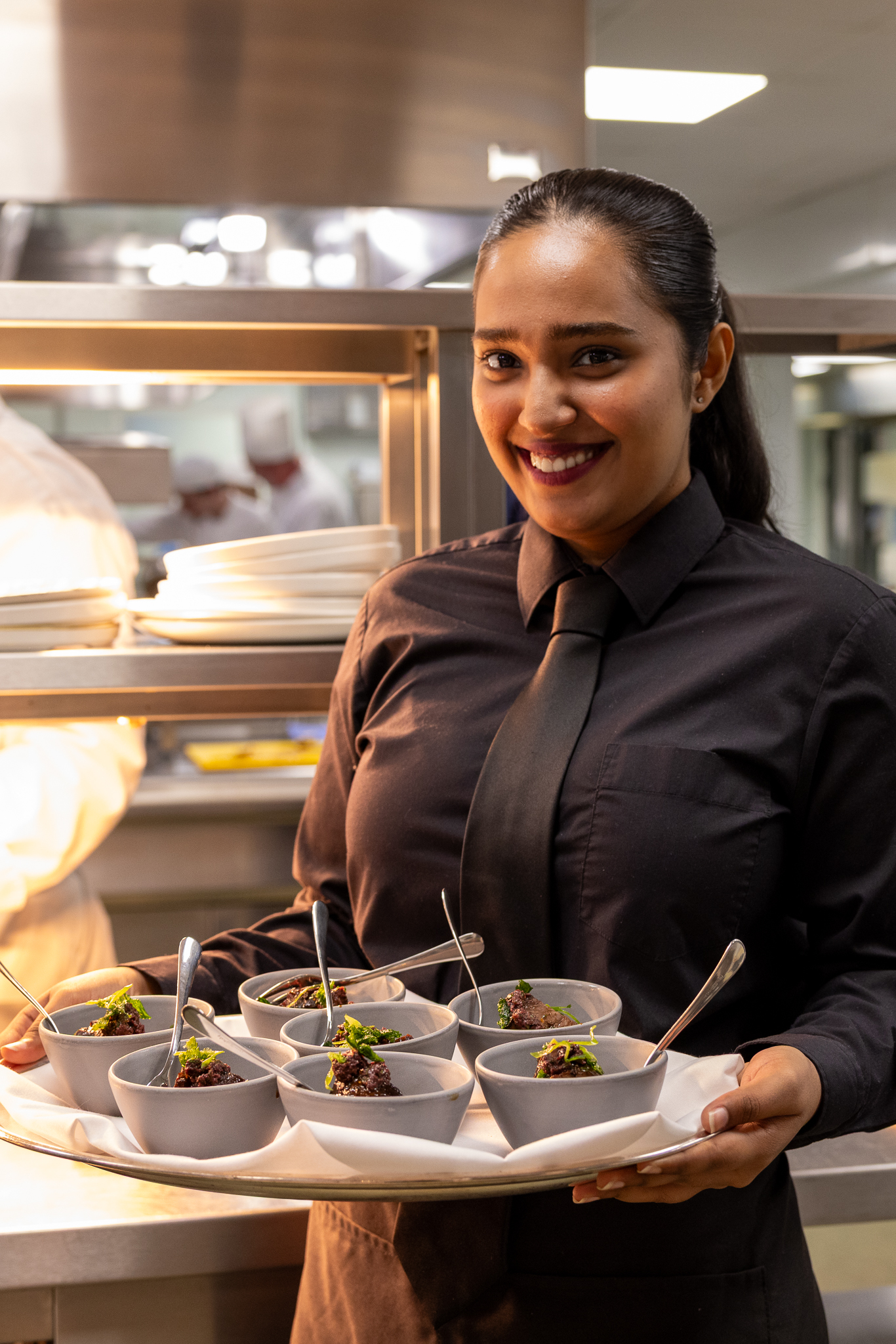 Michael Coaker, Culinary Ambassador at the University of West London curated the event, along with his excellent teaching and management team, he said:
“Our students now have the opportunity to learn how to deliver a luxurious and personalised guest experience, with a clear view into the kitchen so they can watch their special menu being created and prepared by the chefs. We are truly fortunate to have this feature in our training restaurant. The Chef’s Table genuinely allows service, guests, and chefs to interact seamlessly, and we are very grateful to provide this as a luxury dining feature at Pillars.”
 The menu was a powerful demonstration of what culinary education can achieve when creativity, technical training, and mentorship come together. The students, guided by their lecturers, delivered food that felt professional, generous, and celebratory. An achievement that not only honoured the occasion but also highlighted the future talent emerging from the university’s kitchens and training restaurant.
Guests enjoyed the opportunity to explore the space, connect with peers, and reflect on the evolving role of education in shaping resilient, forward-thinking food professionals. Conversations flowed easily between chefs, lecturers, employers, and partners, all united by a belief that collaboration is essential to tackling the challenges facing the sector from skills shortages to sustainability and innovation.
Capturing the opening of The Chefs’ Table felt less like documenting a single event and more like witnessing the start of a new chapter. One rooted in opportunity, ambition, and a shared responsibility to nurture talent with integrity and purpose.
As the ribbon was cut and applause filled the room, it was clear that The Chefs’ Table is not just a physical space, but a platform one that will inspire, educate, and elevate those who step into it for years to come.
Bookings for The Chef’s Table are being taken now: Email the team at pillars@uwl.ac.uk
Photography by Carlos Farinha @carlosclickuk
Chef of the Week Sponsored by Pure Ionic Water: Sam Griffiths, Executive Chef at The Chester Grosvenor
Chef of the Week sponsored by Pure Ionic Water celebrates the chefs that embody Pure Ionic Water’s core philosophy of ‘enhancing the culinary experience‘.
Pure Ionic Water works in many kitchens up and down the country from the pinnacle of Michelin stars to 5-star hotels, uniting them all, the desire to serve the very best. Understanding the difference premium hydrogen enhanced alkaline water makes to food, to the kitchen team’s performance and ultimately to the business’s profits is easy, just ask around.
“I only trust Pure Ionic Water at home and in my restaurant.”
Sat Bains, Chef Parton, Restaurant Sat Bains, 2 Michelin stars
For more information about Pure Ionic Water CLICK HERE
How long have you worked at your current restaurant?
I started as Executive Chef in October 2025, but worked at this hotel between 2016-2023, from Demi Chef de Partie to Executive Sous Chef.
Where did your passion for cooking come from and where did you learn your skills?
Cooking at home with my family.
What do you enjoy most about being a chef?
Service. Having the team pumped and working together to deliver food at excellent standards.
Name three ingredients you couldn’t cook without.
Butter, vinegars, and salt.
Which piece of kitchen equipment couldn’t you live without?
Small crank handle palette knife.
What food trends are you spotting at the moment?
I don’t love to follow trends, I think if something is good it will always do well. That being said, we have found more of a want for choices in a menu rather than just a set tasting menu.
What do you think is a common mistake that lets chefs down?
“That’ll do’’ shouldn’t be in a chef’s vocabulary. It’s a slippery slope!
What is your favourite time of year for food, and why?
Springtime is always full and exciting, but quite a short season of the goodies we get in this country. I also love the challenge of making ‘wintery’ food light and delicate.
Which of your dishes are you most proud of?
I did a dish a few years ago called Hot and Cold Potato. I hope that will make a comeback in one form or another one day.
How do you come up with new dishes?
Brainstorming with people in the kitchen, trial and error, looking through old repertoires and books. But I like to be led by what’s available to us and allowing it to be the best it can be at that particular time.
Who was your greatest influence?
I get my work ethic from my Dad. The get up and go to provide and desire to progress and achieve.
Tell us three chefs you admire.
Gareth Ward at Ynyshir, Adam Byatt from Trinity and Adam Smith from Woven.
What is your favourite cookbook?
I have hundreds. I couldn’t pick one! Different ones take my fancy depending on what mood I’m in.
Who do you think are the chefs to watch over the next few months?
Neil Aitken has recently taken his first Head Chef position at the Forge and I’m excited to see his progress, Harry Redmayne at Barlounge in Chester has an exciting relaunch approaching too, however he has been established in Chester for such a long time already!
What’s been your favourite new restaurant opening of the last year?
I haven’t eaten out a lot in the last year due to having a little boy, however Bonheur by Matt Abé looks outstanding already.
Chefs, Do You Know When your Frying Oil Begins to Break Down?
 Beyond Oil introduces Longevity Technology for Frying – A system designed to manage oil degradation instead of frequent oil replacement.
Every chef recognises the moment when the fryer begins to turn against you. The oil appears darker. The aroma shifts. Chips start colouring too quickly, breaded items lose their crispness, and the kitchen fills with that heavy, burnt frying smell that lingers on your whites long after service.
And yet, most kitchens carry on. Not because anyone wants to serve food with tired oil, but because oil is expensive, deliveries aren’t getting cheaper, and replacing it each time it begins to run out can feel like pouring profit straight down the drain.
The harsh truth is that in many commercial kitchens, frying oil begins to degrade within 3 to 5 days. In reality, it is often used well beyond that point just to keep the business operational.
 That’s where Beyond Oil is starting to garner serious attention. It isn’t a new fryer, a complicated kitchen gadget, or another product that makes lofty promises but adds extra steps to your day. Beyond Oil is a longevity powder designed to function within your existing filtration protocol. The aim is simple: keep frying oil stable, cleaner, and consistent for longer by removing the impurities that cause it to break down.
What makes this interesting for chefs is that it addresses more than just surface mess. When oil starts breaking down, it’s not only crumbs and bits that become problematic. Old oil produces smoke, harsh flavours, and fumes that make the kitchen unpleasant for the team. It can also cause the build-up of unwanted trans fats on the plate, and it increases hidden operational costs through extra cleaning, heavier chemical use, more labour, and sometimes even downtime.
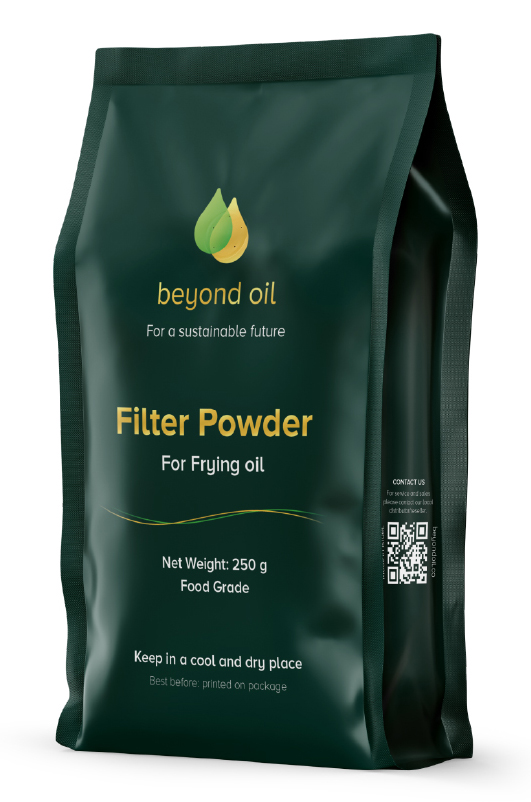 Beyond Oil’s greatest benefit is extending the life of oil from three days to 30 days – that is ten times longer. This revolutionary product can help reduce oil purchases by up to 50%, resulting in fewer change-outs and less waste. For operators monitoring every margin, that’s a significant win, especially when the return on investment is seen as paying for itself through oil savings alone.
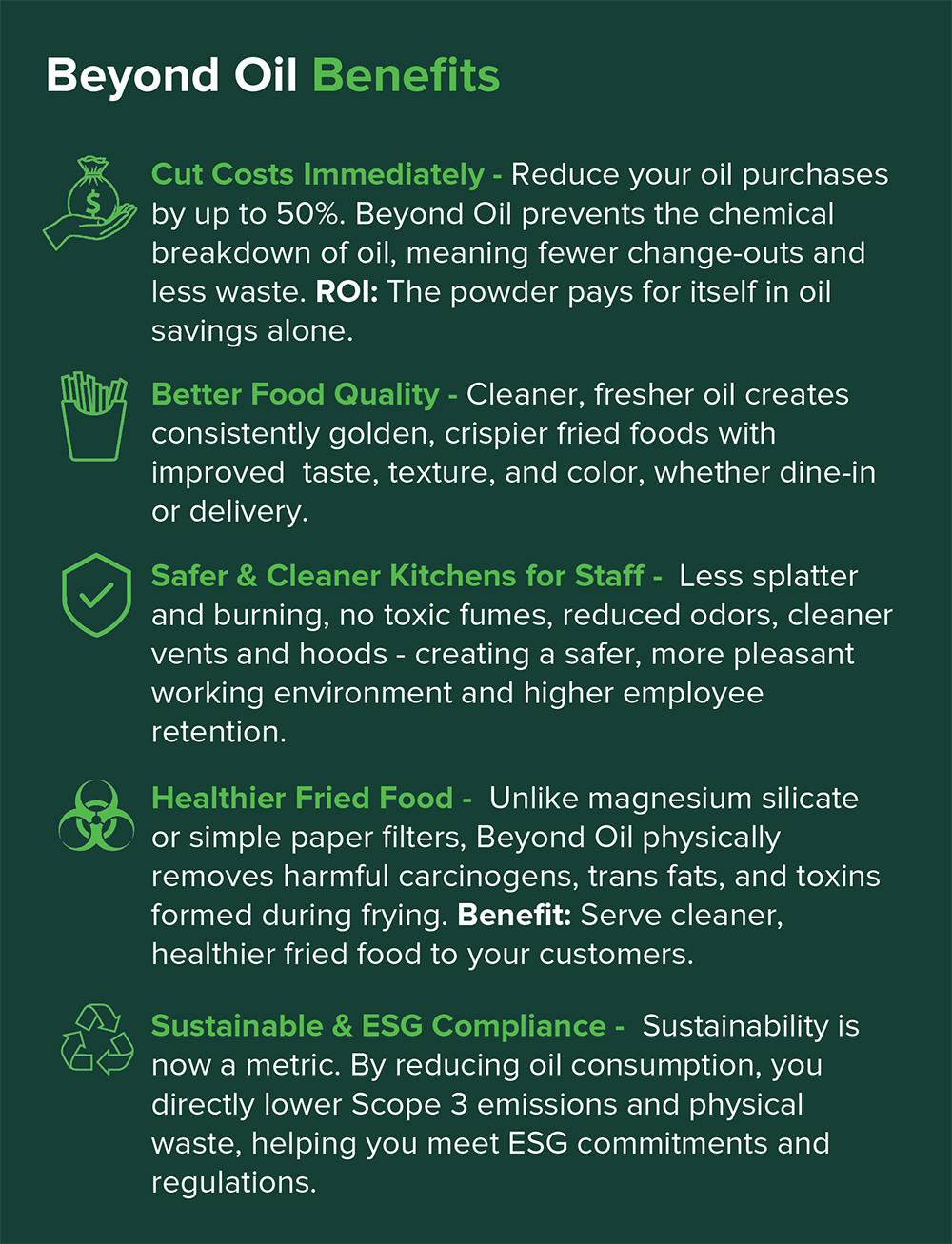 But chefs won’t stick with anything just because it saves money. It has to perform on the pass. Cleaner, fresher oil directly affects food quality, and Beyond Oil is designed to support consistently golden, crisp fried food with better taste, texture, and colour – whether customers are eating it in-house or it’s travelling out the door for delivery.
There’s also an increasing discussion about what “better frying” means for customers. Beyond Oil is created to physically eliminate harmful toxins, trans fats, and other unwanted compounds that can develop during frying, which is presented as an improvement over basic filtration method.
And at a time when sustainability is becoming a genuine commercial metric, reducing oil consumption also means decreasing waste, lowering scope three emissions. This supports ESG commitments and helps diminish the broader impact on the supply chain, which more businesses are now expected to monitor.
By prolonging the life of oil, we decrease the demand for oil, which leads to less deforestation, fertiliser use, refining, shipping, and handling. This prevents the emission of 3.81 kg of CO2e for each litre of oil that is not utilised.

For chefs, however, the most immediate benefit might be the simplest: a calmer fryer section. Less splatter, fewer burning smells, reduced odours, and cleaner vents and hoods can make the kitchen safer. Additionally, not inhaling the hazardous, toxic, carcinogenic fumes that harm the kitchen staff working on the fryer daily makes it more pleasant to work in – and that matters when you’re trying to retain good staff in your team.
In short, Beyond Oil isn’t aiming to reinvent frying. It’s about making it cleaner, more affordable, and more reliable, without forcing chefs to compromise on quality.
 For more information on how Beyond Oil can transform your frying system, contact:
Adrian Sagman for a no-obligation chat on: 07830 752875 or email: adrians@beyondoil.co
Hospitality Advocates for 13% VAT as New Research Warns Sector Is in ‘Stabilisation Mode’
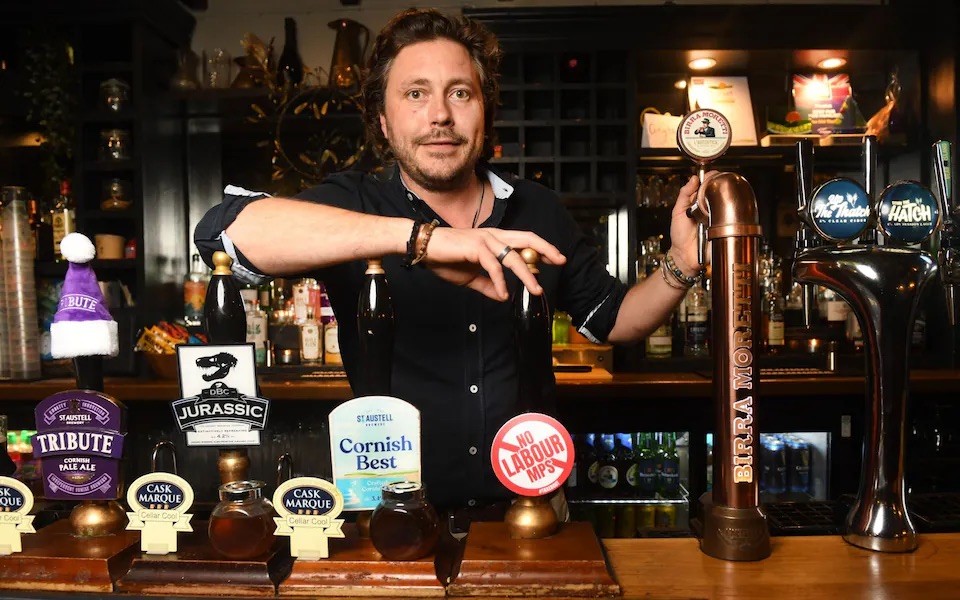 When The Chefs’ Forum was asked to support the ‘Ban Labour MPs’ campaign, we responded willingly. The campaign by Dorset landlord Andy Lennox has gained both national and international attention, and now there is increasing pressure to bring about positive tax reforms for the hospitality sector to help businesses in the industry survive.
A new independent research report is increasing pressure on the Government to reduce VAT on in-house hospitality food and drink from 20% to 13%, with industry leaders claiming that the sector is no longer in recovery but in survival mode.
The study, led by Dr Siamand Hesami of Bournemouth University Business School, describes a VAT cut not as a driver of growth but as an “emergency stabilisation measure” aimed at keeping businesses afloat, protecting jobs, and preventing avoidable closures.
The research shows that UK hospitality continues to face pressure from rising wages, employer National Insurance, energy costs, food prices, and the return of full business rates. Insolvency risk is highest among food-led pubs and lower-margin operators, especially in regions reliant on tourism.
 Accounting and Finance Lecturer and report author, Dr Hesami, stated that the evidence made action unavoidable.
“This research was necessary because the sector is facing structural pressure, not short-term volatility,” he said. “Rising costs, shrinking margins, and fragile consumer demand mean many viable businesses are now at risk. A VAT reduction is one of the quickest tools available to stabilise trading conditions.”
He added that the aim is not to lower prices but to guarantee the survival of businesses.
“This is about cashflow, employment protection, and keeping doors open. If pubs and hospitality venues fail, the damage extends to jobs, suppliers, and local economies.”
The report models a VAT reduction from 20% to 13% on in-house food and drinks, including alcohol, covering pubs, cafés, restaurants, hotels, and hospitality venues serving customers on-site.
Key findings include:
- Hospitality sustains around 2.6 million direct jobs and supports roughly £270 billion (around 10%) of UK GDP through tourism-related activity.
- About 200,000 direct jobs could be protected through a VAT cut, with a total of 372,000 jobs supported when supply chains are included.
- The policy would be 34–38% self-financing, meaning over a third of the cost would be recovered through tax receipts and improved compliance.
- The net cost to the government is estimated at £5.3–£5.5 billion annually, mainly offset by retained jobs and surviving businesses.
Hospitality employs around 2.6 million people directly, with tourism-related employment around 3.8 million, with the strongest impact in coastal, rural, and visitor-led regions.
Crucially, the research demonstrates that VAT cuts do not primarily boost spending, they protect jobs and businesses.
 Andy Lennox, Campaign Leader and Landlord of The Old Thatch pub in Dorset highlighted that the research advocates for clear policy action.
“From this research, the Government should introduce a 13% VAT rate,” he said. “This isn’t about giving the sector a handout, it’s about preventing unnecessary failures, safeguarding jobs, and making trading viable again. Without intervention, we’ll continue losing pubs and hospitality businesses that communities depend on.”
He added:
“Operators have already pushed prices to the limit that customers can accept. VAT reform gives businesses breathing space without penalising consumers.”
Publicans are in survival mode and for operators on the ground, the message is straightforward: The current model is broken.
 Campaign Supporter, Rick Creasman, Owner at Nailcote Hall said:
“We’re trading in survival mode, not growth mode. VAT at 20% on top of wages, energy, and food costs is pushing businesses to the brink. A 13% rate would allow us to reinvest in staff, maintenance, and local suppliers instead of constantly having to cut back.”
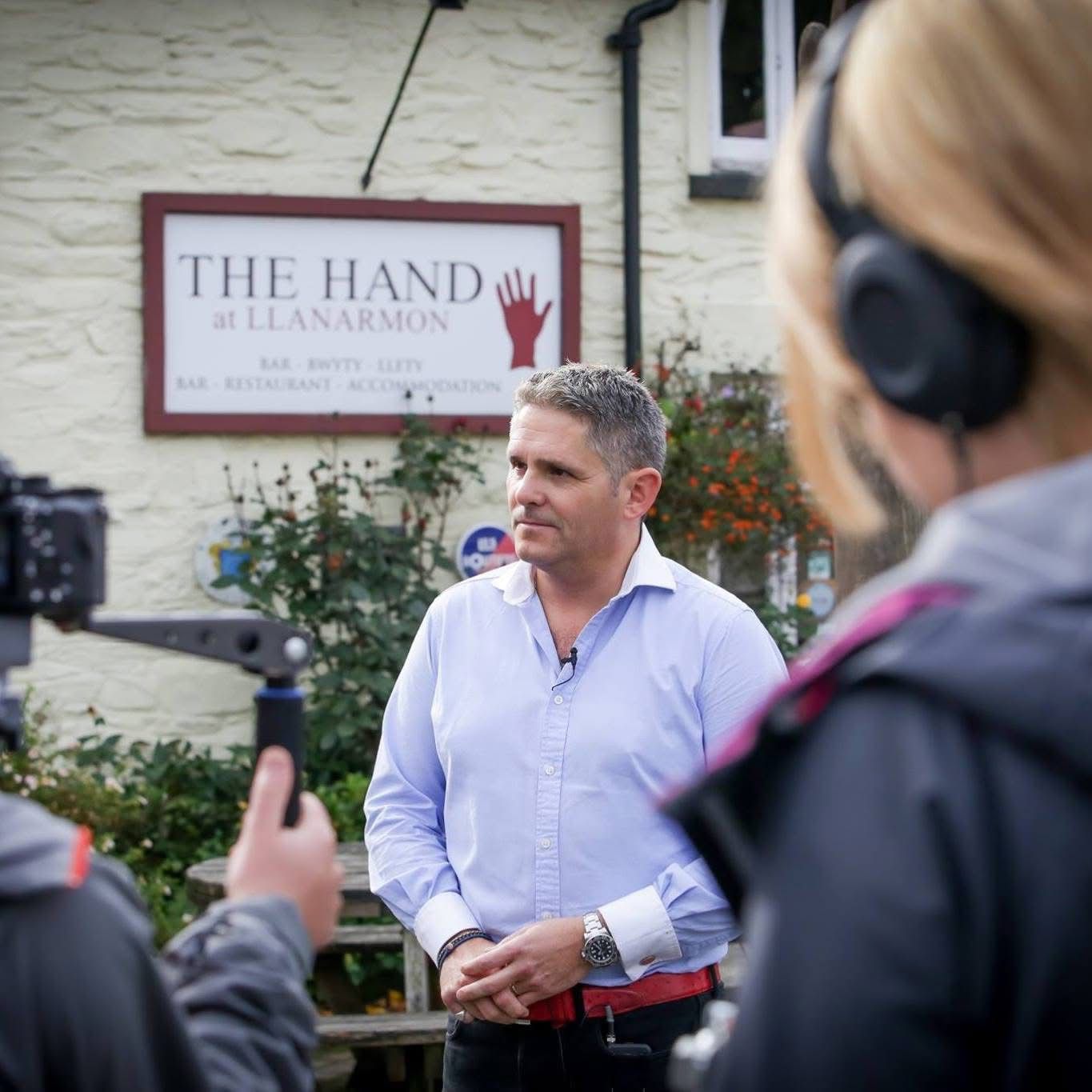 Jonathan Greatorex, Campaign Advocate and Landlord at The Hand at Llanarmon added:
“High VAT kills confidence. You stop hiring, stop refurbishing, and reduce opening hours. A 13% rate would give pubs and hospitality businesses the confidence to plan again and that’s when communities begin to benefit.”
The research posits 13% as a pragmatic middle ground, not a full subsidy, but a stabilisation tool. Many EU and OECD countries already operate hospitality VAT rates between 9% and 13%, while the UK remains at 20%.
The proposal includes a six-month review, enabling the Government to evaluate the effects on closures, employment, and tax revenue before deciding to make it permanent.
As Dr Hesami concluded:
“This isn’t about growth economics. It’s about stabilisation economics. If hospitality collapses, the costs: unemployment, empty high streets, broken supply chains are far greater than the cost of intervention.”
For hospitality professionals, the message is clear: VAT reform is no longer just a lobbying issue; it has become a matter of survival. The message is unmistakable: VAT reform is no longer a lobbying concern; it is now a survival issue. For more information on how to join your peers and support this campaign visit www.thewonkytable.co.uk
From Classroom to Coral: West London College Students Dive into High-End Hospitality at Sexy Fish Mayfair
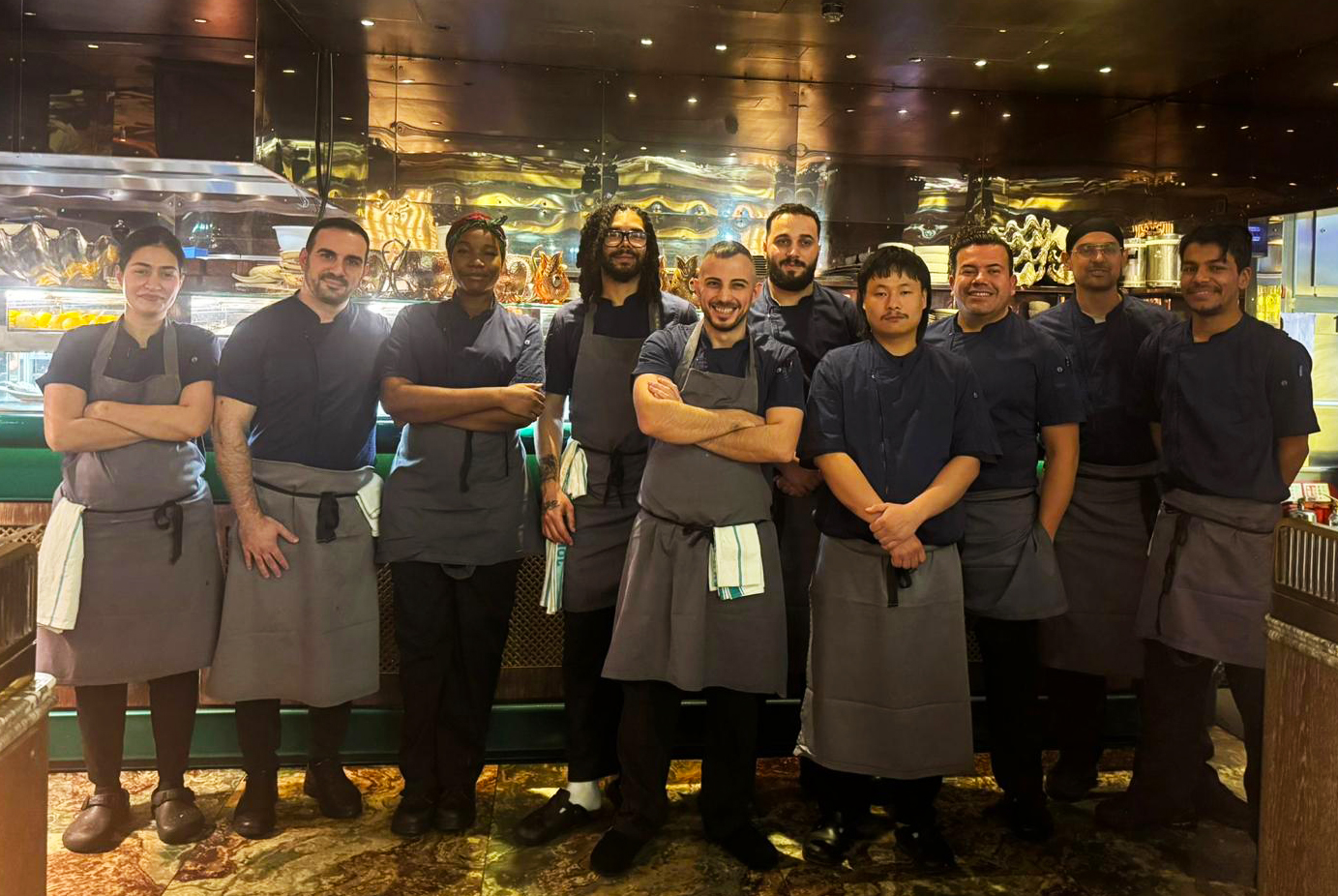 In a move to bridge the gap between vocational training and the world of luxury hospitality, students from The Chefs’ Forum Academy at West London College are currently stepping out of the training kitchen and into the high-octane environment of Sexy Fish Mayfair.
Located in the heart of Berkeley Square, Sexy Fish is world-renowned not just for its Asian-inspired menu and iconic late-night glamour, but for its exacting standards of service and culinary precision. For the visiting students, this offers a rare, behind the scenes, look at how one of London’s busiest premium venues maintains its reputation at the top of the industry.
Beyond just a tour, the students are given the opportunity to work alongside the Sexy Fish team for a week, learning firsthand about the career paths available to them once they complete their education. This opportunity focuses on the importance of the small details, and the difference between good service and the world-class hospitality that Mayfair is known for.
“Seeing the energy of Sexy Fish Mayfair’s service up close has changed my perspective on what’s possible in my career. It’s not just about cooking, it’s an art. The atmosphere and the perfection in every single plate.” – Aslan Dsouza, Student at West London College.
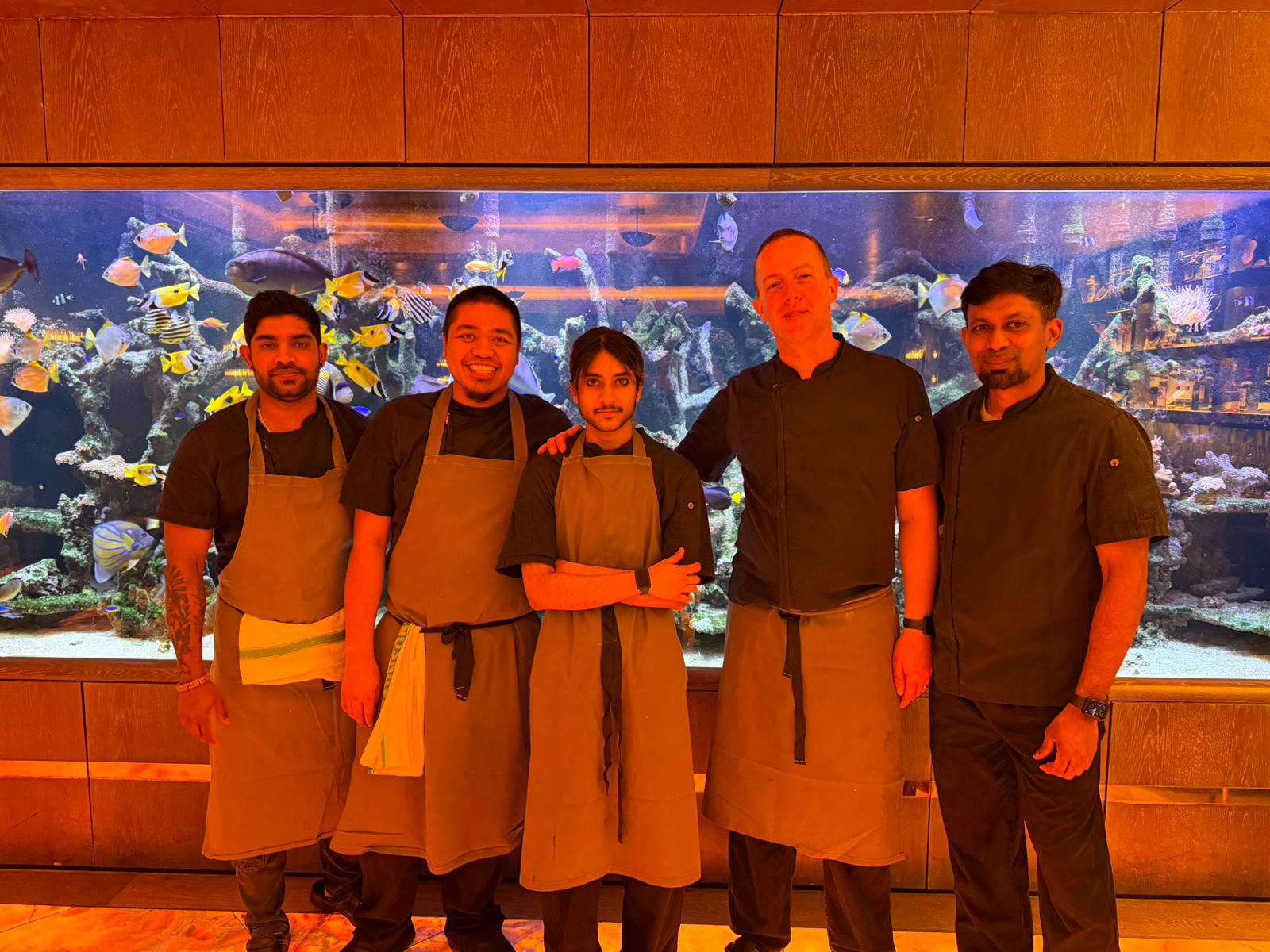 The collaboration highlights the ongoing commitment of The Chefs’ Forum Academy and West London College to provide its’ learners with industry-leading exposure. By connecting students with iconic brands like Sexy Fish, this ensures that the next generation of chefs and hospitality managers are not just job-ready but industry-inspired.
“Opportunities like this are transformative for our students,” said Denise Charles, Head of Curriculum, Service Industries at West London College. “To see the level of discipline and creativity required at a venue like Sexy Fish gives them a tangible goal to work toward. It turns the theory they learn in the classroom into a real-world career path.”
Mattia Ricci, Executive Chef at Sexy fish added, “It is fantastic to have the West London College students with us in the kitchen for work experience. At Sexy Fish, we thrive on high energy and passion, and seeing these students rise to that challenge in real-time is inspiring. There is no substitute for the ‘live’ environment of a busy Mayfair service, and they are doing a great job of soaking up every detail.”
A huge thank you to the management and culinary team at Sexy Fish Mayfair for hosting our Chefs’ Forum Academy students and investing in the future of British hospitality.